





Visual alarm devices for fire: An introduction and guide to BS EN 54-23
BRE (Building Research Establishment) is an independent, research-based consultancy, testing and training organisation, operating in the built environment and associated industries.
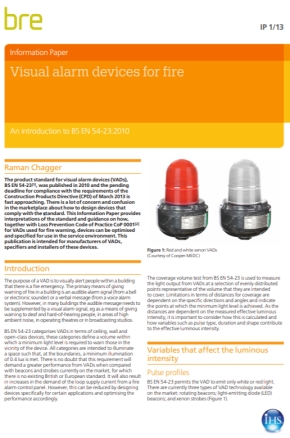
On 28 February 2012, BRE published Visual alarm devices for fire: An introduction and guide to BS EN 54-23.
The purpose of a visual alarm device (VAD) is to visually alert people within a building that there is a fire emergency. The primary means of giving warning of fire in a building is an audible signal (from a bell or electronic sounder) or a verbal message (from a voice alarm system). However, in many buildings the audible message needs to be supplemented by a visual alarm signal, eg as a means of giving warning to deaf and hard-of-hearing people, in areas of high ambient noise, in operating theatres or in broadcasting studios.
The product standard for VADs, BS EN 54-23, was published in 2010 and the deadline for compliance with the requirements of the Construction Products Directive (CPD) was March 2013. This Information Paper provides interpretations of the standard and guidance on how, together with Loss Prevention Code of Practice CoP 0001 for VADs used for fire warning, devices can be optimised and specified for use in the service environment.
This 12-page publication is intended for manufacturers of VADs, specifiers and installers. Its contents are:
- Introduction.
- Variables that affect the luminous intensity.
- The coverage volume test.
- Testing and approvals for VADs.
- Codes of practice for VADs.
- Conclusions.
- References.
Ref https://www.brebookshop.com/details.jsp?id=327102
[edit] Related articles on Designing Buildings Wiki
- BRE articles on Designing Buildings Wiki.
- BRE Buzz articles on Designing Buildings Wiki.
- BRE Buzz.
- BREEAM.
- Building Research Establishment.
- Visual alarm devices - their effectiveness in warning of fire.
- Automatic fire detection and alarm systems, an introductory guide to components and systems BR 510.
- Evacuating vulnerable and dependent people from buildings in an emergency FB 52.
- Fire detection and alarm system.
- Fire detector.
- Fire.
- Heat alarm.
- Ionisation smoke alarms.
- Optical smoke alarm.
- Personal protection watermist systems in the homes of vulnerable people.
- Smoke detector.
- The causes of false fire alarms in buildings.
- Understanding the factors affecting flashover of a fire in modern buildings.
Featured articles
Check out some of the best features and news from Designing Buildings as well as key stories from around the web.
Code of Practice for Electrical Energy Storage Systems.

ECA calls on members to comment on draft 4th edition.

Bringing together expertise and creating cultural benefits.

CIOB celebrates positive Ofsted report.

The Building Safety Regulator announces a call for evidence.

Government approach could undermine delivery and regeneration.
World's first mass timber data centre.

The overlooked environmental aspect of data centre development.
Introduction to radon awareness

New technical information sheet published by CIOB.

Updated supplier guide can help electrical contractors engage with NHP.

CIAT confirm the winners of the 2026 architectural technology awards.

Government launches a one stop shop for flood preparedness.

Sir Edwin Lutyens: Britain's greatest architect? Book review.

CIOB publishes free template to help assess and manage risks.